
Speed read
The past year handed investors three certainties.
- Gold at a record $5,589 an ounce proved the dollar was finished,
- Bitcoin near $126,000 was the escape from debasement.
- SpaceX, listed at $135 a share in the largest IPO in history, made the future investable.
The verdicts followed fast: gold is 27% below its record, Bitcoin has roughly halved, and SpaceX ran from $135 to $225 and back to $147 inside a fortnight. Knowing every headline in advance would still have produced a poor outcome. That is why what protects a portfolio is decided earlier, in how it is built, because by the time the storm has a name, the ship is already built. Or it isn't.
Key takeaways
- Three mutually exclusive certainties commanded full conviction inside nine months. Each demanded a different portfolio, and each disappointed the investors who acted on it.
- Robert Shiller, a Nobel laureate, showed that stories move markets whether or not they prove true. How convincing a story sounds tells you nothing about how it’s ending.
- Even accurate foresight was not enough. Knowing gold's record, Bitcoin's peak and SpaceX's listing in advance would still have exposed an investor to round trips that punished the timing.
- A portfolio sized so that being wrong about any single story barely matters is worth more than a correct forecast. Those decisions are made in calm conditions, before the headline arrives.
Every headline brought a new certainty
The most dangerous thing in markets over the past year was a convincing story. There were plenty.
Gold reached a record $5,589 an ounce on 28 January, carried by an argument that felt airtight: governments would inflate away their debts, so the only safe money was the metal. Bitcoin told the same story with a different ending; if paper currency was being debased, the escape was digital, and at its October ‘25 peak of $126,198 the case looked settled. Then in June this year, SpaceX priced the largest listing in history at $135 a share, raising $75 billion at a valuation near $1.8 trillion. Commercial space was the future, and the future was finally investable.
Each argument was rational. Each came with data and serious people behind it. And each demanded a different portfolio.
Robert Shiller won a Nobel Prize partly for explaining what happens next. In Narrative Economics he showed that stories spread through markets the way epidemics spread through populations, and that they move prices whether or not they turn out to be true. How fast a story travels tells you nothing about whether it is right. Fluency is not evidence.
What perfect information was worth
Suppose you had known every one of those headlines in advance, word for word, before publication. You would still have had to survive what the market did with them.
Gold now trades near $4,075 an ounce, 27% below the January record, after touching an eight-month low in early July.
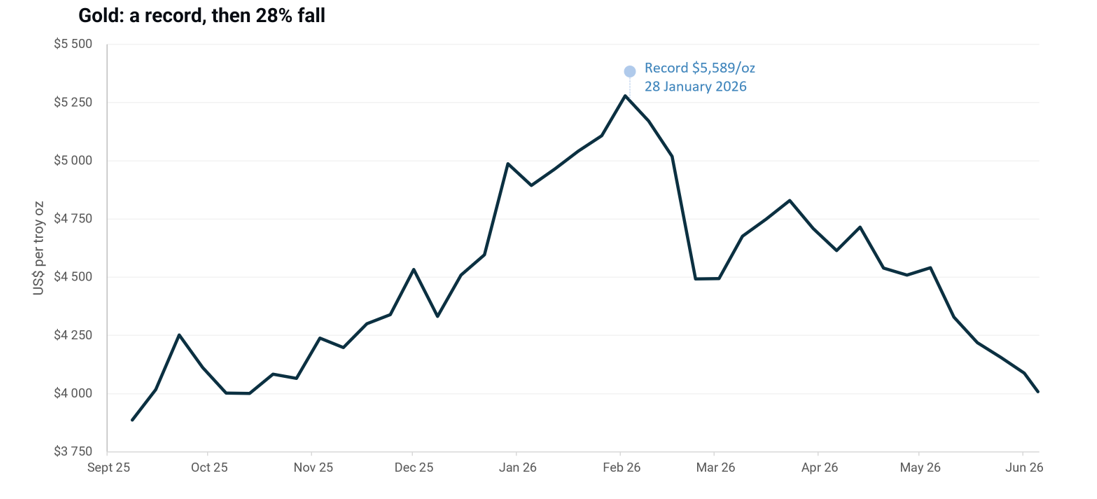
Source: Bloomberg, PortfolioMetrix. Price in USD per troy oz, weekly data from 2025/09/26 to 2026/06/30.
Bitcoin ended June around $58,500, roughly 54% below its peak, closing out its worst month since June 2022. The debasement it promised to protect against never arrived.
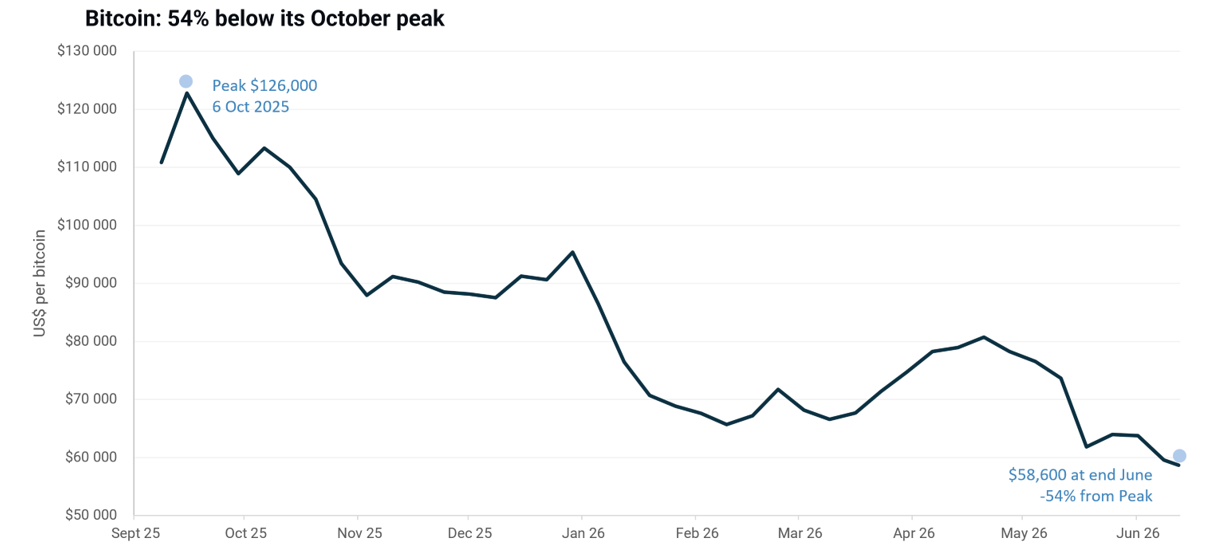
Source: Bloomberg, PortfolioMetrix. Price in USD per bitcoin, weekly data from 2025/09/26 to 2026/06/30.
SpaceX is the sharpest case, because even the winner was untradeable. It closed its first day at $161. Four days later it touched an intraday $225.64 on 16 June. A week after that, $147.11 on 23 June. It closed 1 July at $157.54, above the $135 offer price and about 30% below its peak. The story never changed. The same share was a triumph and a bust inside a fortnight. Which of those prices was perfect information about commercial space worth?
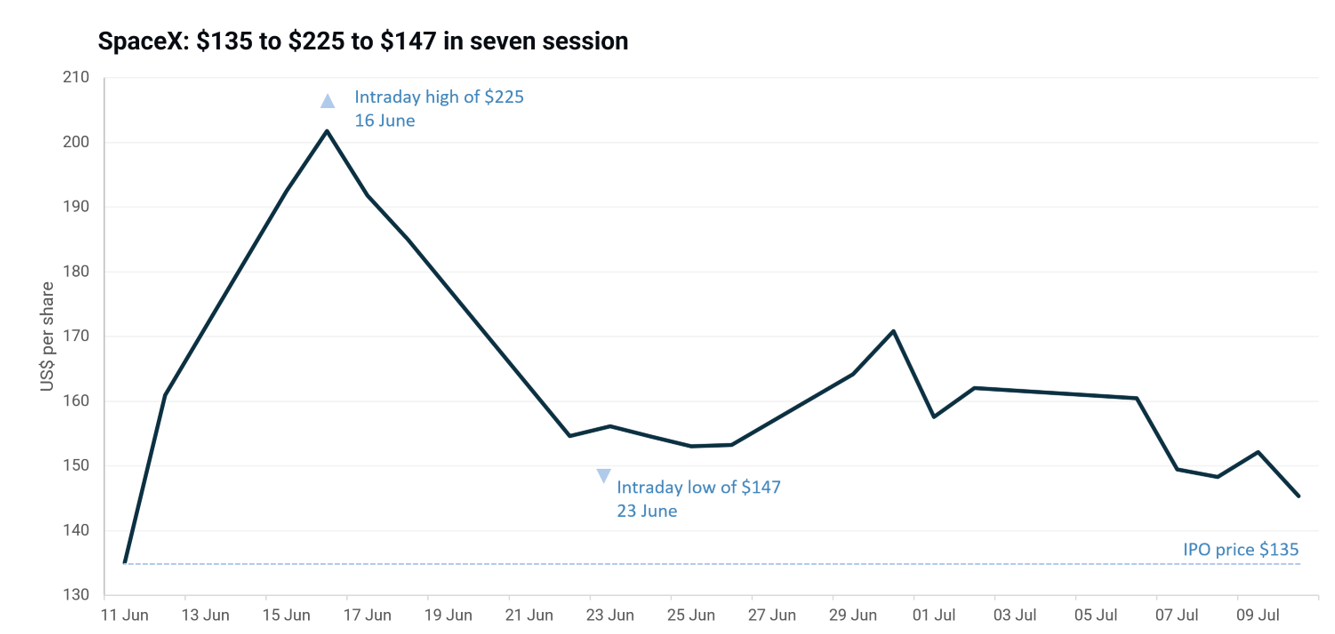
Source: Bloomberg, PortfolioMetrix. Price in USD per share, daily data from 2025/09/26 to 2026/06/30.
And the dollar, the currency two of those trades were built to escape, sits at a 15-month high, firmed by 4.2% US inflation in May and a Federal Reserve priced for higher rates. The premise underneath the loudest trades of the year quietly reversed while everyone argued about them.
The headline was knowable. The market's reaction to it was not.
The certainties could not all be true
Put the three stories side by side and something awkward appears. Gold and Bitcoin claimed the same collapse and sold rival shelters against it. SpaceX asked investors to take concentrated equity risk at a $1.8 trillion valuation, while the debasement trades argued that paper assets were doomed. These were mutually exclusive arguments, all commanding full conviction, within the same nine months, sometimes from the same commentators.
This is Shiller's point exactly. A story's spread and a story's truth are different things. Fluency moved these prices on the way up and offered no protection on the way down. The information was free and the conviction was expensive.
Ships are built in calm water
A ship gains no strength once the storm arrives. Whatever was built in the harbour is what goes to sea.
Portfolios work the same way. The decisions that determined how a portfolio behaved through this period were taken months or years earlier, in calm conditions, when no headline was demanding anything. How much any single story is allowed to matter. How many independent sources of return the portfolio actually draws on, rather than three names holding the same bet underneath. What gets sold, mechanically, when one position runs and another lags. None of those decisions improves under pressure, and none of them can be made well in the middle of the event they are meant to withstand.
A portfolio that needed gold to hold $5,000, or Bitcoin to stay above $100,000, or one listing to keep climbing, discovered that dependence this quarter. A portfolio built so that no single outcome could move the total by much kept compounding through all three. That is not luck, and it is not a call. It is a property engineered in advance and then left alone.
Built that way, a portfolio will always look underexposed to whatever is loudest at the time. That is the design, not a defect. The discipline that keeps it out of the full weight of a winning story is the same discipline that keeps it out of the full weight of the losing ones. Over a full cycle, the losing stories are the more common of the two, and our approach of consistently compounding discipline smooths out returns and engenders greater investor trust.
The client conversation this invites
At some point a client may have asked why the portfolio held so little gold in January, or Bitcoin last year, or none of the listing everyone was discussing in June. The question deserves a direct answer, and there is a good one. The portfolio was never going to stake its outcome on a single story being right, and that decision was taken long before the headline formed. The same sizing that missed gold's record also missed the 27% fall that came after it. You do not get one without the other.
Markets will keep manufacturing certainties. Some will pay. Most will round-trip the way these three did. The only question that matters for an investor is whether the portfolio depends on telling the difference in advance, or whether it was built so that being wrong about the next certainty barely registers.
By the time the storm has a name, the ship is already built. Or it isn't.
References to gold, Bitcoin and SpaceX are included for illustrative market commentary only. These examples may involve higher volatility and should not be read as recommendations or as suitable investments for all investors.