
Speed read
Retirement often triggers a portfolio overhaul: less in shares, more in cash and bonds, or separate buckets for near-term spending. These changes may make the plan feel safer, but they do not remove the central risk of having to sell investments after markets fall. Research from Kitces and Pfau shows why the order of returns matters so much, particularly early in retirement. Longer lives create the opposite danger: becoming too cautious and giving up the growth needed to sustain income over 30 or 40 years. Morningstar research shows that dynamically adjusting the withdrawal rule, while keeping the asset mix unchanged, can lift the starting withdrawal rate from 3.9% to as much as 5.7%. The strongest retirement strategy therefore combines an appropriate portfolio with flexible withdrawals and an ongoing plan that is reviewed as markets and circumstances change
Key takeaways
-
A portfolio can look safer without becoming more sustainable. Bucketing and de-risking may help investors understand and stick to a plan, but neither removes sequence risk.
-
The first decade of retirement matters disproportionately more because withdrawals taken after early market losses leave less capital available to recover.
-
Retirement outcomes are shaped by three connected levers: what the portfolio owns, how income is drawn and how the plan is adjusted over time
Feeling safer and being safer aren’t the same thing
Retirement often creates an understandable urge to do something visible. Equity exposure is reduced, cash is increased and savings may be split into separate buckets: cash for the first year's income, bonds for the next few years and growth assets for everything beyond that. The portfolio looks more orderly and may feel easier to live with. That psychological benefit is valuable. A structure that helps someone understand the plan and remain committed to it can improve behaviour. But feeling safer and being safer are not always the same thing.
Kitces (2014) compared a bucket strategy with a conventional, rebalanced total-return portfolio. Where the asset allocation, withdrawals and rebalancing rules were equivalent, the two approaches produced much the same investment outcome. Rebalancing was already doing the work that the buckets appeared to do: selling assets that had risen and replenishing those that had fallen behind. The labels changed, but the underlying mathematics did not.
The real risk is the order in which returns arrive
The central problem is sequence risk. Two retirees can earn the same average return over retirement and still experience very different outcomes. The difference is often the order in which those returns arrive. Losses early in retirement are particularly damaging because withdrawals are being taken from a falling portfolio. Every unit sold to fund spending is no longer available to participate in the recovery. By contrast, the same loss much later in retirement usually has less time to compound through the plan.
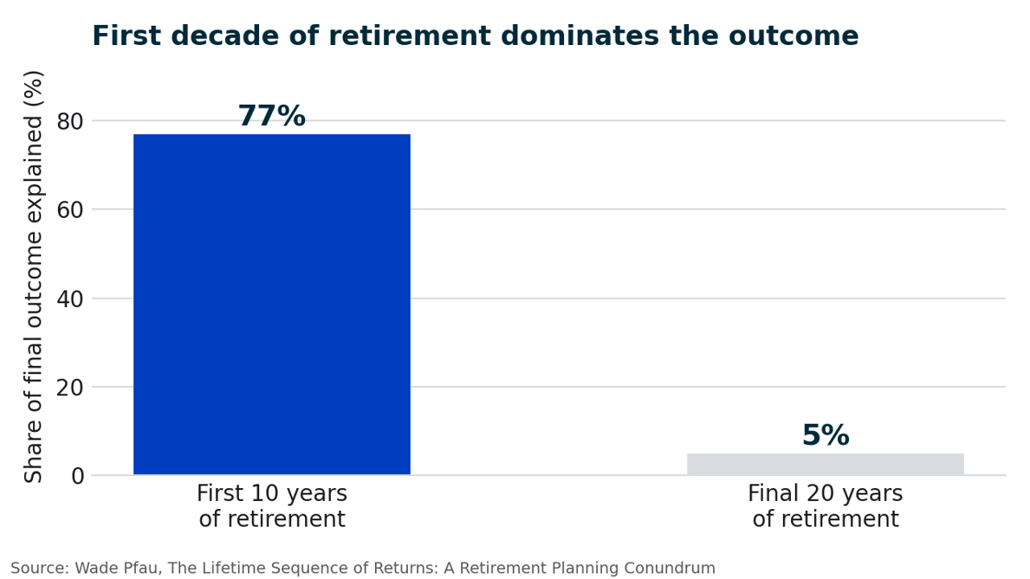
In Pfau's (2013) analysis, the compounded return earned during the first 10 years of retirement explained roughly 77% of the variation in the final outcome. Returns during the final 20 years explained only about 5%. The first decade therefore carries a disproportionate amount of the risk.
Bucketing does not make that risk disappear. Eventually, the cash bucket must be replenished from the growth assets. If that refill happens after markets have fallen, the retiree is still selling low at precisely the point when the damage can be greatest.
Longevity creates the opposite danger
Sequence risk explains why early losses matter. Longevity explains why a retirement portfolio cannot simply retreat into cash and bonds.
The Office for National Statistics (2025) estimates period life expectancy at age 65 at 18.7 years for men and 21.2 years for women in the UK. Measures that allow for expected future improvements in mortality run higher – increasing to nearly 20 years and 23 years for men and women respectively. For many retirees, a 30-year planning horizon is no longer uncommon. Some portfolios may need to provide an income for 40 years or more. Over that length of time, insufficient exposure to growth assets can become a risk in its own right.
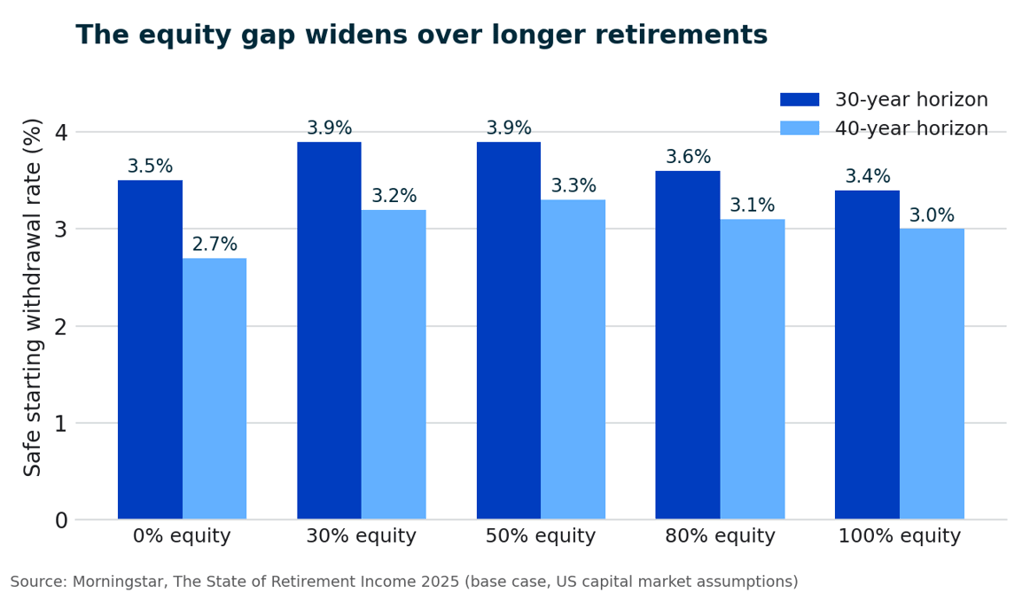
Morningstar’s (2025) research shows that the longer retirement lasts, the more costly it can become to hold too little growth. Over 30 years, a portfolio with no equity exposure supported a 3.5% starting withdrawal rate, compared with 3.9% for portfolios holding between 30% and 50% in equities. Over 40 years, that gap widened to 2.7% versus as much as 3.3%. Defensive assets can soften early market falls, but over a longer retirement the portfolio also needs enough growth to sustain withdrawals and preserve purchasing power.
Lowering risk can reduce the size of early drawdowns, which may help with sequence risk. But it also weakens the portfolio's long-term growth engine and increases the risk that inflation erodes its buying power. A portfolio can therefore feel safer in the short term while becoming less resilient over the full retirement journey.
Three levers shape retirement outcomes
A resilient retirement plan depends on three connected decisions.
- The portfolio: the balance between growth assets, defensive assets and cash.
- The withdrawal rule: how much is drawn, how quickly spending rises and what happens after weak markets.
- The ongoing plan: the behavioural coaching, tax decisions, rebalancing and regular reviews that keep the strategy aligned with the retiree's needs.
These levers cannot be considered in isolation. A more growth-oriented portfolio may support higher lifetime spending, but it also brings greater short-term volatility. A more conservative portfolio may deliver steadier early returns, but at the cost of lower expected growth. A flexible withdrawal rule can help bridge that tension by asking spending to respond when market outcomes differ from the original assumptions.
The withdrawal rule can materially change the result
Morningstar (2025) modelled how much starting income a retirement portfolio could support under different withdrawal approaches. Its base case assumed a fixed, inflation-adjusted withdrawal over 30 years and a 90% probability of the portfolio retaining a positive balance at the end of the period. Under that rule, the highest starting withdrawal rate was 3.9%.
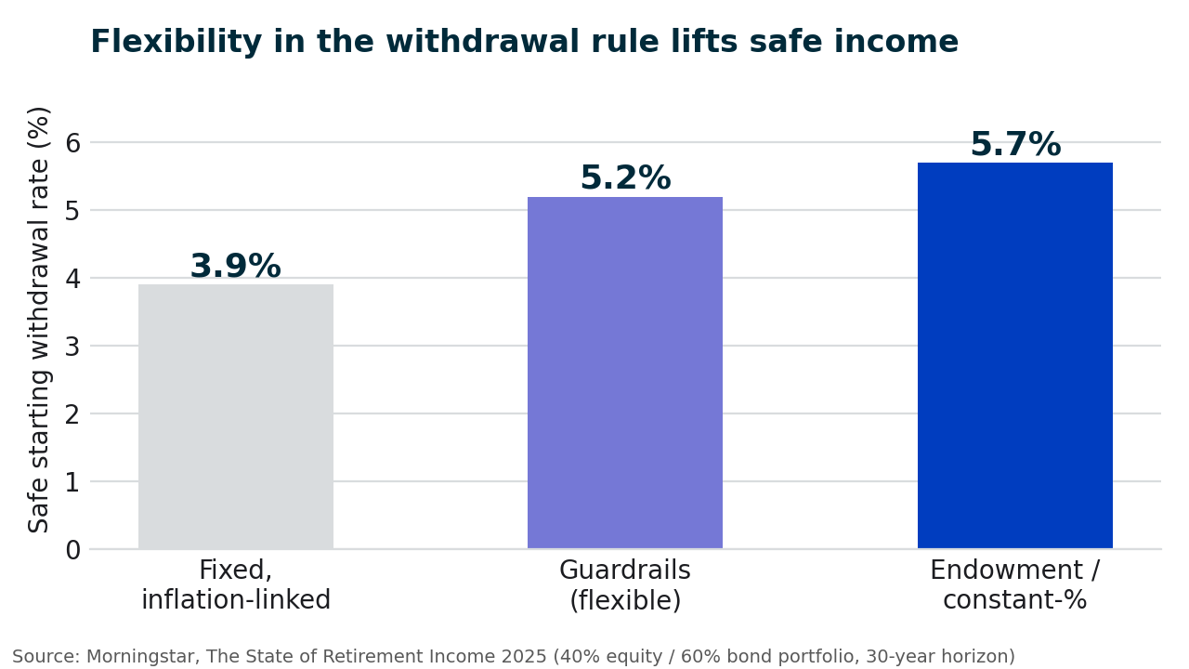
The outcome changed when spending was allowed to respond to market movements. More flexible approaches increased the starting withdrawal rate, with the highest reaching 5.7%. The portfolios did not become more aggressive. The improvement came from the spending rule: withdrawals could rise after strong markets and fall after weak ones.
There is no free lunch. Flexible higher starting withdrawal rates generally came with less predictable income from year to year. That trade-off may be difficult for retirees whose essential expenses depend heavily on portfolio withdrawals, but more manageable for those with pensions, annuity income or other reliable sources covering their basic needs.
The important point is not that every retiree should start at 5.7%. It is that the method used to draw income can materially change what the same portfolio is able to support
Value is created around the portfolio
Vanguard's (2025) research reinforces the same broader conclusion. It estimates that behavioural coaching can add up to 2% or more in net returns, while a tax-efficient retirement withdrawal strategy can add up to a further 1.12%, depending on the investor's circumstances. Those gains do not come from finding a different fund or making the portfolio more complicated. They come from improving the decisions made around the portfolio: helping investors remain committed through difficult markets, choosing an efficient order for withdrawals and revisiting the plan as tax rules, spending needs and market conditions change.
The Financial Conduct Authority's work shows why this matters. Its Retirement Outcomes Review (2025) found that some people drawing from pensions did not know where their money was invested, while others remained heavily in cash. Its later review of retirement-income advice also found that the quality and completeness of advice varied. A retirement strategy cannot be set once and assumed to remain suitable indefinitely.
What this means for you
None of this suggests that the portfolio is unimportant. Asset allocation remains one of the main determinants of risk and return, and meaningful exposure to growth assets will still be necessary for many retirees with long time horizons. The mistake is to assume that retirement risk can be solved through changing the asset mix alone. Bucketing, cash reserves and de-risking may all have a role, particularly when they help a retiree stay invested and meet near-term spending needs. But they work best as parts of a broader income plan rather than substitutes for one.
A total-return approach remains powerful because it does not force the portfolio to chase natural yield. Income can instead be created from whichever source is most sensible at the time. But total return is not, by itself, a withdrawal policy. It still needs clear rules for how much is drawn, when assets are sold and how spending responds after difficult markets.
The safest retirement portfolio is therefore not necessarily the one with the least equity, the most cash or the most buckets. It is the one supported by an appropriate withdrawal policy, enough long-term growth assets and an ongoing plan that is reviewed as markets and personal circumstances change. Value comes not only from the portfolio's asset exposure, but from the decisions made around it before and after retirement.
References
Financial Conduct Authority (2024). Thematic review of retirement income advice. [online] Financial Conduct Authority. Available at: https://www.fca.org.uk/publications/thematic-reviews/thematic-review-retirement-income-advice [Accessed 3 Aug. 2026].
Financial Conduct Authority (2025). Retirement outcomes review. [online] Financial Conduct Authority. Available at: https://www.fca.org.uk/publications/market-studies/retirement-outcomes-review [Accessed 3 Aug. 2026].
Kitces, M. (2014). Managing Sequence Of Return Risk With Bucket Strategies Vs. A Total Return Rebalancing Approach. [online] Kitces.com. Available at: https://www.kitces.com/blog/managing-sequence-of-return-risk-with-bucket-strategies-vs-a-total-return-rebalancing-approach/ [Accessed 27 July 2026].
Morningstar (2025). The State of Retirement Income: 2025. [online] Morningstar, pp.1–54. Available at: https://www.morningstar.com/business/insights/research/the-state-of-retirement-income [Accessed 27 July 2026].
Office for National Statistics (2025). National life tables - life expectancy in the UK: 2022 to 2024. [online] Office for National Statistics. Available at: https://www.ons.gov.uk/peoplepopulationandcommunity/birthsdeathsand marriages/ lifeexpectancies/bulletins/nationallifetablesunitedkingdom/2022to2024 [Accessed 3 Aug. 2026].
Pfau, W.D. (2013). The Lifetime Sequence of Returns: A Retirement Planning Conundrum. SSRN Electronic Journal. doi:10.2139/ssrn.2544637
Vanguard (2025). Quantifying Adviser’s Alpha® in the UK: Putting a value on your value. [online] Vanguard. Available at: https://www.vanguard.co.uk/professional/research/quantifying-advisers-alpha-in-the-uk-putting-a-value-on-your-value [Accessed 3 Aug. 2026].